I love sharing free resoruces. Here are my favorite recent freebies. Make sure to also check out our full free curriculum list here.
Bible/Character
Future Flying Saucers Bible Lessons
Most of the lessons/resources in her store are free!
35 Bible Verse Coloring Pages
Faith Like Joseph Coloring Pages
10 Commandments Booklet
Character First Sample Lessons/Activities (secular resource)
Haven't been through all of these but seems like some good lesson resources.
Science
Anatomy & Physiology, Logic of Medicine (Expires 3/31)
FULL YEAR online high school science courses.
Math
Cut and Paste Addition Practice
If you don't actually "paste" these can be kept in baggies and reused over and over for practice, so they can be worth the ink.
Language Arts
Contraction Dominoes
Mixed/Other
Reading Passage and STEM Project - Design a Playground
Has a story and science project. Work on Language Arts and science simultaneously? LOVE IT!
Feelings Faces
A fun way explore emotions with your kids.
American Sign Language Alphabet Flash Cards

Monday, February 27, 2017

Sunday, January 1, 2017
Year in Review + Top Posts of 2016

I went briefly from a homeschooler of one to a homeschooler of two at the end of the summer...which sadly, didn't go as well. My middle child wanted to try homeschooling, but for various reasons he was only going to homeschool for a year before returning to public school, and after a trial month it wasn't going as well as it needed to (because of me, not him), and he ended up returning to public school. If we had more wiggle room...more time to ease into to it without heading back so soon I might have stuck with it, and I still wonder if I should have. But he's been doing well back in public school, and I think it was what was best for our family.
We started co-op with me teaching my first class there (a short, three week class on Ships and the Sea...which was so fun. I grew up on a boat so it was right up my alley).
We went from "at our own very slow pace" Story of the World to doing it with a group doing two chapters a week. It's been a year of trying new things.
My homeschooled son has gone from a boy who hated reading to falling in love with Piggie and Elephant books, even CHOOSING to do his reading first in stead of putting it off til last. Woo hoo! We still have so long to go but that's some progress I can get excited about.
And of course there was this blog. While it officially started December 2015, I didn't really start working on in it earnest until this August this year. My most popular posts of this year were...
Funny thing I noticed when researching that little list...since August I've had visitors every day (at least a few), except one...Christmas day. And that makes my heart glad. I appreciate all of you who visit and read my blog, but that's a good day to NOT be reading blog posts...*grin*. I hope you all had a precious, wonderful time with your family this Christmas, and have a happy, happy, new year!
Saturday, December 31, 2016
Happy New Year!

Ring Out, Wild Bells
by Alfred, Lord Tennyson
Ring out, wild bells, to the wild sky,
The flying cloud, the frosty light;
The year is dying in the night;
Ring out, wild bells, and let him die.
The flying cloud, the frosty light;
The year is dying in the night;
Ring out, wild bells, and let him die.
Ring out the old, ring in the new,
Ring, happy bells, across the snow:
The year is going, let him go;
Ring out the false, ring in the true.
Ring out the grief that saps the mind,
For those that here we see no more,
Ring out the feud of rich and poor,
Ring in redress to all mankind.
Ring out a slowly dying cause,
And ancient forms of party strife;
Ring in the nobler modes of life,
With sweeter manners, purer laws.
Ring out the want, the care, the sin,
The faithless coldness of the times;
Ring out, ring out thy mournful rhymes,
But ring the fuller minstrel in.
Ring out false pride in place and blood,
The civic slander and the spite;
Ring in the love of truth and right,
Ring in the common love of good.
Ring out old shapes of foul disease,
Ring out the narrowing lust of gold;
Ring out the thousand wars of old,
Ring in the thousand years of peace.
Ring in the valiant man and free,
The larger heart, the kindlier hand;
Ring out the darkness of the land,
Ring in the Christ that is to be.
Happy New Year!!
Thanks to Graphics Fairy for the Bells Illustration
Shared on Throwback Thursday
Ring, happy bells, across the snow:
The year is going, let him go;
Ring out the false, ring in the true.
Ring out the grief that saps the mind,
For those that here we see no more,
Ring out the feud of rich and poor,
Ring in redress to all mankind.
Ring out a slowly dying cause,
And ancient forms of party strife;
Ring in the nobler modes of life,
With sweeter manners, purer laws.
Ring out the want, the care, the sin,
The faithless coldness of the times;
Ring out, ring out thy mournful rhymes,
But ring the fuller minstrel in.
Ring out false pride in place and blood,
The civic slander and the spite;
Ring in the love of truth and right,
Ring in the common love of good.
Ring out old shapes of foul disease,
Ring out the narrowing lust of gold;
Ring out the thousand wars of old,
Ring in the thousand years of peace.
Ring in the valiant man and free,
The larger heart, the kindlier hand;
Ring out the darkness of the land,
Ring in the Christ that is to be.
Happy New Year!!
Thanks to Graphics Fairy for the Bells Illustration
Shared on Throwback Thursday
Thursday, December 29, 2016
Story of the World: Vol 1 - Chap 4 - Making Mummies

We had already read about the mummification process in several different library books on Egypt, so I wanted to take a different tack and look at the science behind how mummification works.
Nit-Picky Fact Check: Technically,the mummification process described in Chapter 4 of Story of the World was really not fully developed until the New Kingdom (though I don't know if I would have cared enough to tweak this if there hadn't been other reasons to).
For our alternative text we used a page from "Science of Ancient Egypt: Mummification" (part of a larger bundle on Ancient Egypt by Dr. Dave's science which I bought after falling in love with his free sample unit on The Nile). It covered some things that the other books we read didn't about the science behind making mummies (like how microorganisms are involved in breaking down bodies, and how Natron, the salt mixture the Egyptians used in mummification, prevented these from growing by removing moisture).
While the Unit Study was for 4th - 7th graders, we did this when my son was a 1st grader with a Kindergarten sized attention span. I felt like the material was engaging and kid friendly enough for him to handle...especially since he loves science. (And I was right)
I didn't try to cover the whole unit though, since I knew that would be an attention span stretch. In stead I used a couple of pages from it for this lesson, and I did what I always do...added some tactiles and visuals, and of course, lots of questions.
First, we reviewed Egyptian mummification with this video...
Then, before we dug into the text, I took my son outside to see something I knew had been sitting out by the fence in our yard...the remains of a dead bird. I knew it would be a great example of what happens to an animal after it dies...and how microorganisms take part in that process (though I'm sure ants took a part too).

Feel free to save and print this picture as an alternative to
viewing a real decomposing animal.
I pointed out the bones and the beak and the feather, and asked my son "What do you think happened to the rest of it, all the bird's muscles and stuff?"
He gave a guess about the bird going to heaven (theology lessons pop up when least expected, don't they?).
"Well, the Bible doesn't say whether birds go to Heaven. Some people think they do, and some people don't, but we don't know. But when people go to Heaven it says God gives us new bodies...so our old bodies stay here when we die. So even if animals go to Heaven it doesn't mean their bodies do too. So what do you think happened to the bird's body?"
I let him give a couple more guesses and then said, "Lets go inside and find out!" That got him interested and he listened intently as I read the whole page on "Preserving the Body" which talked about how microorganisms break up and consume dead things and how the mummification process prevents that.
At that my son expressed some fears about microorganisms eating him...so I told him about how when we're living that our cells have ways of fighting bad bacteria and germs, and that other bacteria lives in our body and doesn't hurt us, but when someone or something dies than its cells die too, and so the microorganisms then start to eat the dead cells.
(Yeah, all that...it was all off the cuff and I wasn't sure if that was completely correct, though it did assuage his fears. Later I checked up on it and got this great answer from someone on Answers.com. I was pretty on target...but he gave some extra details that were really great. That answer isn't around anymore...but there's a similar one on Quora)
While the video below doesn't directly answer that question, it does describe the process of decomposition and would be a good resource to share with older kids for this study. I don't suggest this for younger kids because some of the illustrations could be scary for them (though every kid is different...you could preview it and see if you thought it would work for your child). After minute 2:27 it talks about the problem of burial space/cost and some solutions, which is not as related to this lesson, so you may want to stop there (though it is interesting).
If your kids are interested in learning more about what we do with bodies to prepare them for burial today, this page also has good information.
We skipped the next page of the mummification unit study ("Salt) to come back to after we had done our egg experiment (as it gives away the end), and read the first paragraph of "The Chemistry of Salt." This paragraph talks about how salt is a mixture and how there are different kinds of salt (even baking soda is, chemically, a salt). So, I showed him some....

Aw, the salt looks like a funny monster face.
Click on it to see the different salts enlarged.
We looked at regular salt, coarse ground sea salt, Himalayan sea salt, Epson salts, and baking soda. I left these out on a dish for him touch and play with while I read the next paragraph about natron. When we got to the last paragraph about where the Egyptians got natron (in the Natron Valley, in the Nile Delta), we looked it up on our map.
MAP TIPS: Most ancient Egyptian maps won't have the Natron Valley labeled. It's located on the west side of the Nile Delta (the river area shaped like a V where the Nile meets the Mediterranean. "Wadi El Natrun" is it's current name, which is actually Arabic (so, a later name). In Coptic (the language descended from the ancient Egyptian language), it is called Šihēt, meaning "Measure of the Hearts." (This may still be tied to it being a source of the natron used in mummification, since in ancient Egyptian religion, the heart was weighed before a person could enter the afterlife).Egg Mummy Experiment
We followed up our study with an experiment where we mummified a hard boiled egg. I've seen this done with apples too, or a whole chicken (as suggested in the SOTW Activity book). Several day into our experiment, we read the page on "Salt" that we had earlier skipped, after making guesses as to why our egg had shrunk and hardened.
- Hard boil an egg (or two if you want to have a "control" egg...see section below). Peel off the shell.
- Measure the egg with flexible tape ruler and write down results.
- Weigh egg and write down results.
- Mix an equal amount of salt and baking soda to make an approximation of natron (you can just use salt in stead)...enough to cover an egg.
- Put the egg in a cup or open container and cover completely with natron mixture.
- Uncover egg and repeat steps 1 - 3 every day for several weeks until the weight and size remains constant.
CONTROL EGG
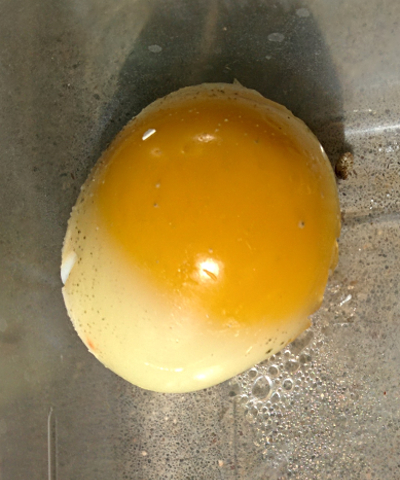
We also put another egg outside in an open container to see what happened to it (but did not measure it, because I knew after a while we wouldn't want to touch that one). In stead we took pictures.


Below are our pictures of our egg mummy (left) and control egg (right). OK, yes, that first picture is the same egg reversed...cause I didn't take a picture of the mummified one before we put it in the salt. It's not consecutive days because we didn't take a picture every day (the days shown are as follows: Day 1, Day 2, Day 5, Day 9, Day 12), and the sizes are not completely to scale, though I did try to show how they shrunk (it was a little more dramatic than the pictures here show, actually). But you can still get the general idea.
Click to see larger pictures.
   
 |
|
(We missed taking a picture of the mummified egg that last day shown, but I thought the changes in the other egg were interesting). The control egg eventually withered away to nearly nothing and we tossed it. The mummified egg eventually turned rock hard and gray, but alas I
didn't take a final pic. I left it outside and then forgot about it a long time and it was gone (guess it didn't stay forever, but we live in a humid area, not the dry Egyptian desert). Plus, some animal may have eaten it.
This was a fun lesson and my son really enjoyed it. I would recommend this experiment for any kids interested in mummies.
Alternative/Additional Activities
Mummify a Chicken (Also in SOTW Activity Book)
Explore and Egyptian Tomb (Ramesses VI)
Explore Museum Collections of Egyptian Mummies and Artifacts Online
(Note, this includes a paid resource...which I haven't previewed. But if you scroll past that there is also links online museum collections you can explore.)
Explore Museum Collections of Egyptian Mummies and Artifacts Online
(Note, this includes a paid resource...which I haven't previewed. But if you scroll past that there is also links online museum collections you can explore.)
You can find this post on the Family Friday Link-up,
Hip Homeschool Mom, Homeschool Blog and Tell, The Bookshelf, Throwback Thursday and other great linky parties.
Subscribe to:
Posts (Atom)