Tuesday, March 17, 2020

UNIT STUDY: Africa

Africa is an area of the world that too often gets shortchanged in our study of history, so I've sought out resources to learn more about the many cultures and and people's on this vast continent. 

The following is a collection of fun activities, videos, and books for learning about Africa.   Some of these are things I've already shared related to our regular history lessons, but I'm collecting them here for those wanting to do a separate Unit Study of Africa.  


This post contains some affiliate links through which I can earn commission


SECTION 1:   AFRICA TODAY
This sections explores various areas and people in Africa today.   I suggest doing these activities over several days. 

Africa Overview

Africa is a continent with various cultures, landscapes, and over 50 different countries.  


This short video gives kids an idea about how wonderfully diverse this continent is.


Platteklip Gorge, South Africa


What Life is Like In Africa


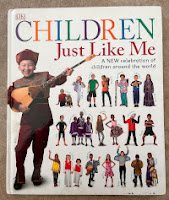
Picture of book Children Just Like MePicture of cover of book, Children Just Like Me (New Edition)
Children Just Like Me is a wonderful book that features modern children from different countries around the world, including many from Africa.  

I would read about these children, maybe over several days if you have kids with short attention spans, and look up the country they are from on a map afterwards. 

The newer version of this book features children from Morroco, Ethiopia, Tanzania, Botswana, Ghana, and South Africa.   The older version of this book has a different set of children (from Egypt, Botswana, Ghana, Morocco, and Tanzania, and Ethiopia).  Only the older book is also available free online through Open Library)

You could also see if there are any 365 degree online virtual tours in on the World Map at Round Me in the country that the children are from.    I suggest letting kids explore  the other "blue dots" in Africa in this site as well, as many as they would like to explore.

I also suggest Africa, Amazing Africa:  Country by Country for learning more about the various countries in Africa.   It explores 55 different African countries, covering cultural highlights about each in a few short paragraphs, in an engaging and kid friendly way.   I suggest pairing it with Children Just like Me, reading about the countries the children come from.  If you have more time, you might want to read the whole thing all the way through.    And if any of the countries pique your child's interest, and they want to learn more, check out the great homeschool resource list on African and African countries here.   We don't have resources on all 55 countries yet, but the list will keep growing! Also, check out the craft book under the "More African Crafts" section below...you might find a craft to go with the country you are learning about too. 


African Homes


A village with round mud houses with grass roofs
Picture of houses  in Nakpanduri, Ghana by Hugues

When I taught about Africa in our homeschool co-op, we were learning about African history, so I decided to have the kids make a traditional round house model, a traditional style of house which can be found in many areas of Africa.

Before we started the craft, though, I wanted to show the kids some examples of other types of buildings people in Africa live in.   Because while people do live in houses like that in parts of Africa, even today, they also live in cities like this....

Large city with skyscrapers - Table Mountain, South Africa


So I filled up this pinterest page not just with the traditional grass roofed round-houses, but modern houses and other interesting buildings in various African countries (and a few landscapes just for fun).    I'm so glad I did.  The kids were fascinated by the variety of houses I showed them--they really loved seeing the different styles.  And a few of the kids were really surprised to learn that African cities had skyscrapers.  Worldviews were expanded, and that made my day.


Tataoine buildings - a picture by Ksar ouledsoltane06
Berber Grain Silos in Tataouine, Tunisia
Photo by Asram (Self-photographed) via Wikimedia Commons 


I found out something pretty cool while browsing those building pics on Pinterest.  The buildings above are from a town in the middle of the Sahara called Tataouine...and yes, if that sounds a lot like Tatooine, the Star Wars planet, it's because it's name and style of buildings did inspire Tatooine in the original Star Wars Series. George Lucas didn't do any filming there but did film some scenes in another nearby Tunisian town.


CRAFT: ROUND HOUSE MODEL  

So, sorry I don't have pictures to share of the clay round-house, but it's pretty simple.   For a small solid house, just roll the clay on a flat surface until you have a round tube a little bigger than a quarter.   Cut the tube down so it's not too high.   Shape the top into a cone and top with dried grass for the roof.   Use a small tool like a toothpick or chopsticks to embed a "door" into the house. 

I tweaked this activity found in this book with activities related to Africa, which has many more great African activities.


More African Crafts
Traditional Crafts from Africa by Florence Temko, which you can also view for free at Open Library, has lots of fun African crafts and information about the countries and areas of Africa where they originate.   It would be fun to go through the book, pick a craft to do, and look up the country it's from on a map.  


You can also find some fun crafts in the free sample pages from Geography Through Art.


SECTION 2:  African Folk Tales

Folk tales are a great way to learn about an area's culture.  Your best bet for finding great African Folk tales to read is just to sit yourself down in your local library in their folk tale/fairy tale section, and find the section with African books (there often is one).   But, I do have a few suggestions. 


Ananse's Feast - An Ashante Tale
Ananse stories are popular folk tales in West Africa.  We enjoyed Ananse's Feast, a children's book we found in our local library (you can also find it free online through Open Library).  It has charming pictures with African cultural details. 

If you would like to read more Ananse stories, there's a good chance you will be able to find some more at your library too. Searching for these folk tales can be a bit tricky, though, because there are various spellings of the African names involved ("Ananse" is often also spelled Anansi, and some versions of these tales just call him "Spider.")

ACTIVITY:  COOK AFRICAN FOOD
You can cook some of the traditional food mentioned in the story for an extra activity. I did a little research and I think these are the foods that were described (though I'm not sure about the Yams...there were several recipes with yams it could have been). 


Though this book doesn't mention the spider's name, I'm pretty sure this is another Ananse tale...this time tied to the legend of how Kente Cloth, a traditional textile found in Ghana, was created.   I found out about this book over at Kitchen Table Classroom, and loved it's beautiful, colorful illustrations.  

You can also find this book free online at Open Library.


ACTIVITY:  KENTE CLOTH CRAFT

Kitchen Table Classroom also had a fun craft you can do along with this story making Kente Cloth patterns on paper (which you can see above).    The post also talks about the meaning of the colors of Kente cloth and a little bit of it's history.


Children Just Like Me:  Our Favorite Stories

This book has favorite stories from some of the children featured in the original Children Just Like Me (the one published in 2005).   Two of those stories are from Africa, one from Botswana and one from Morocco.   The stories are short and the illustrations are beautiful.  (Sadly, I couldn't find this one on Open Library, but I suggest it as it makes a great pairing with Children just like me. ).


I don't have activity suggestions for these stories, but they would be great if your children wanted to learn about other folk tales from around Africa. 


SECTION 3:   History of Africa
The video and book selections below are by no means a complete history of Africa, but just a sampling of historical events from ancient history to about the 1700s.   However, if you want to get a general overview, you can explore this world map through time map (focusing on Africa).   Underneath the map it shows major developments during each time period.

Though Egypt is absolutely part of Africa and it's history,   I am not addressing Egypt directly here because Egypt is usually well covered in any world history curriculum, while the rest of African history is often under represented.   Plus it's very easy to find other resources on Egypt.   I do suggest finding a good book or video on Egypt to fill this out if Egypt hasn't already been covered in your history curriculum. 


Prehistoric and Ancient Africa (Kerma, Nubia/Kush)


The Lost Kingdom of Kush by TedEd (4.34 minutes)
This short animated video sums up the history of the Kingdom of Kush.  It doesn't get into as much detail as the video below, but is a good quick video, especially for younger kids.

Lost Kingdoms of Africa: Nubia  (46 minutes)
This is a great documentary, and while it's not specifically aimed at kids, my son who was 7 at the time we watched this enjoyed it quite a bit (though I skipped over some parts).

I went ahead and charted out the minutes for your convenience below, to help you decide what parts to use and good stopping points if you break this up in sections, or want to watch only part of it.   However, the video I had used was taken down and I had to find another one, so this might be slightly off.  

I find younger children really enjoy the first part about the Rock Gong and Rock Art, but are less interested in other parts.

0 - 4:20 - Intro
4:20 -  7:41 - Rock Gong, beginning of Nubian culture
7:42 - 10:56 - Rock Art and Climate Change (When the Sahara Was Green)
10:56 - 14:20 - Kerma (main city in Kush/Nubia) and Deffufa (huge brick structure)
14:20 - 16:48  - Kerma Pottery
16:49 - 21:41 - Kerma Burial Plot
21:42 - 21:45 - What Happened to Kerma (transition)
21:45 - 26:34 - Egyptian Invasion/Jebel Barkal
26:35 - 29:19 - Sufi Mystics Today at Jebel Barkal
29:20 - 34:40 - Nubians Regain Rule/Tarharka Dynasty
34:41 - 38:43 - Desert Encroaches/Meroe
38:44 - 40:56 - Iron
40:56 - 41:58 - Desert Encroaches Again
41:59 - 45:41 - Nomads
45:42 - End   - Central Sudan (Modern Times)

The following activities would be a good follow up to this video.


ACTIVITY:  SAHARAN ROCK ART CRAFT

This rock art would fit in nicely after learning about the rock art in the Sahara (first three sections of video above).   Before doing this activity I suggest looking at some examples of Saharan rock art here.

First, collect rocks to paint on.   Red, black and brown are common colors for ancient rock art, because these pigments can be made more easily from things found in nature than some other colors.    We just used regular paint in these colors for the rock art painting shown below, but if you have time you can also make your own paint using minerals or gathered material, which would be really fun.  For older kids, this article has more about prehistoric paints, and they have some links toward the bottom to paint-making activities that explores the chemistry behind it (a nice way to add in an little science).

Here's our rock art.   Our son really enjoyed this.


This picture shows a rock painted with a bull and an archer

This picture shows the other side of the rock painted with hunters and animals.


The rock art craft pictured was actually from a craft we did while studying the
Lascaux caves in France and Native American rock art in California, but when I saw the Saharan rock art I thought this activity would work well here as well.


ACTIVITY:   MAKE MUD BRICKS


The Kerma Duffafa (explored in the Nubia video above, in minutes 10:56 - 14:20) was a huge structure made of mud bricks.   They most likely made them similarly to how the Egyptians did.   You can learn how to make mud bricks with your kids here. (Requires woo, mud from your back yard, and optional grass).


SUGGESTED BOOK - FOR NUBIA


Ancient Egyptians and Their Neighbors
If you want your children to learn more about ancient Nubia and do some crafts or activities related to it, this is the best book I've found with activities on the subject for children.  It  has a whole section on Nubia as well as sections on the Hittites, Mesopotamians, and Egyptians (a small section on the Nubian pharaohs is, if I remember right, in the section on Egypt).  The only thing I dislike about this book is that it's entirely in black and white (save for the cover).  Sadly this book is not available on Open Library.


Middle Ages to Renaissance


MANSA MUSA AND THE EMPIRE OF MALI

VIDEO:  Mansa Musa - by TedEd
(3.54 minutes)

A good short animated video about Mansa Musa, possibly the richest man who every lived, and his famous pilgrimage.   I would watch this or the next video on Mali (which includes the story of Mansa Musa), but you wouldn't need to watch both. 

VIDEO SERIES:  The Empire of Mali - by Extra Credits
(Series)
This animated web series covers not just Mansa Musa, but the Kingdom of Mali.  It has 10 videos, each about 8-10 minutes long.  I liked how this put Mansa Musa in context, and spoke more of the great civilization of Mali.   (Contains some animated historical violence - preview before showing younger children).

Free Lesson on Mansa Musa from Stanford History Education Group

KINGDOM OF AKSUM


VIDEO: Lost Kingdoms of Africa - Ethiopia (58.51 minutes)
This video covers the medieval kingdom of Aksum, in the area that is now Ethiopia.


QUEEEN NZINGA AND THE MATAMBA KINGDOMS


VIDEO:  Queen Nzinga Part I
  and Part II by Extra Credits

Queen Nzinga was a 17th-century queen of the Ndongo and Matamba Kingdoms in what is today known as Angola, who fought for the freedom of her people from the Portuguese.  (Contains  historical violence - preview before showing younger children).


Early Modern Period
I haven't done as much on the modern period, so I apologize that this is rather sparse.

THE ZULU


Shaka by Diane Stanley
A beautifully illustrated and well written children's book about the story of Shaka.   The pictures are engaging very child friendly, though it does have descriptions of violence, so preview before reading to younger children.    This book is also available for free on Open Library.


VIDEO:  The Zulu - by Extra Credits
(web series)

A great video about the Zulu that's more kid friendly than the Shaka Zulu movie. 
(Contains historical violence - preview before showing younger children).


Friday, September 20, 2019

Story of the World Ancient Times - Chapter 13 - Amenhotep and King Tut


The second last half of this chapter of Story of the World deals with the king Amenhotep (later Akhenaten), a Pharaoh who briefly transformed religion and art Egypt, and King Tutankhamun, who during his short reign, changed everything back.    As always, I offer my suggestions for activities and other ways to enhance the reading below.

This post contains some affiliate links through which I can earn commission. 


SUGGESTED BOOK:  ANCIENT EGYPT REVEALED

As you know, I ALWAYS look for pictures from library books or online to illustrate the chapter (cause for my visual learner, one black and white pic isn't enough).   Usually, any kids books related to the subject will have some pictures that would work to illustrate the chapter and it doesn't really matter which one you get...but for this subject this book was SO PERFECT for illustrating that I think it's worth searching for specifically (maybe even doing interlibrary loan for).    It had a really good pictures of Amenhotep...a large statue of him and a wall carving of him and his wife Nefertiti, and more pictures of her on another page (search for Akhenaten, his other name, in the index to find it)  But where it really shines for this chapter is the TWO special lift the flap pages related to King tut (see pictures and/or video below).  


Amenhotep

One interesting thing about Amenhotep/Akhenaten that SOTW doesn't mention is how he changed art in Egypt.   For thousands of years before Akhenaten, and for nearly 1000 years after his reign, Egyptian art remained largely the same.  But for a brief period of about 60 years during his reign and shortly afterwards, the style of artwork in Egypt changed.   This period of time was called the Armana period.  The videos below all share a little something about this...

VIDEO SUGGESTIONS

TICE ART 1010 - Ancient Near Eastern and Ancient Egyptian Art (4 min)
This video is about Ancient Egyptian Art in general (and Mesopotamian art, but I've set the link to start at the Egyptian section), and is done in a cartoon style that would be fun for even young kids to watch.    It only briefly covers the art of the Armana period, but I like it because it shows what Egyptian art was like before and after that period, for contrast.

Armana Period (10 min)
This video covers more about both the religious and  artistic changes during this period.   Sadly it's a little grainy and may not be as fun for younger kids.

Egypt's Armana Period (11 min)
The first half of this video first talks about the discovery of King Tut's Tomb (so would be a great tie-in between the first and last parts of this SOTW section), and from 4:46 on talks about Amenhotep/Akhenaten.   It mostly focuses on the religious changes but gets into the art style change a bit too.  It's a very engaging video.


ILLUSTRATION SUGGESTIONS
Good places to find illustrations to use in the chapter.   


King Tut

ILLUSTRATION SUGGESTIONS
Nearly all children's books on Ancient Egypt will have some illustrations of King Tut.   The original version of SOTW had an illustration of his mask in the chapter, and the Revised has a coloring page of it the activity book.   You can also find beautiful pictures of the mask and other art and statues of King Tut with a quick search online.

But again I want to recommend DK Ancient Egypt Revealed for illustration here. The "lift the flap" pages on Tutankhamen (transparent pages that show part of the picture underneath, and as you lift the page more detail is revealed) were a really dramatic way to illustrate this part of the chapter (as I showed on the video below).   This also shows some cool techniques I have for organizing the illustration pages I use from other books while reading Story of the World.   The video also features the book Make It Work:  Ancient Egypt that had some good illustrations of Tutankhamen's tomb.


ACTIVITY IDEAS

Pharaoh Headress Printable (wearable)

3D Egyptian Death Mask

Make Pharoah's Crock and Flail

Coloring Page (Crowning/Marriage)

Coloring Page (mask) 

How to Draw King Tut


VIDEOS

PBS Special on King Tut (27 minutes)

King Tut's Tomb and Armana Period  (11 minutes)
I mentioned this one earlier but am mentioning it again.  The first half of this video first talks about the discovery of King Tut's Tomband from 4:46 on talks about Amenhotep/Akhenaten.

Ancient Civilizations for Kids -Ancient Egypt
From 1:30 - 5:59 has a really good dramatic retelling of the discovery of King Tut's tomb.   It reminds me of the description in SOTW.


BETWEEN THE CHAPTERS

The Bronze Age Collapse  is a significant event that takes place less than 100 years after King Tut reigned in Egypt.    It's not addressed in SOTW but after this chapter would be a good place to add it in.  Extra Credits History has a good short kid friendly video on it.


Last :: Next

Saturday, August 17, 2019

Bug Party Fun!


Our bug themed party the year my son turned seven was, by far, my favorite party we've had with the kids ever.    Everything worked, yet it still felt simple.   Part of it was due, I know, to a bunch of parents who choose to stay, help where needed, and a group of kids that just got along so well.   But we had some neat games and activities I wanted to share with you all too. 


This post contain some affiliate links through which I can earn a commission. 


THE GAMES


Game 1:  Cocoon Wrap


We had a race to see who could wrap their partner in a toilet paper "cocoon" the fastest.   When everyone was done the kids burst out of their cocoon in a spectacular explosion of toilet paper.   Luckily we had a lot of adults present to help clean up the mess.   (Totally worth the mess, by the way...the bursting out was unplanned and magical)


Game 2:   Fly Catching

Sadly I don't have pictures of this, but there is a great game we found on 100 Days of Play using party blowers to catch "flies" (like a frog would with its tongue).   The kids were giggling all the way through this game...it was so much fun.  
SUPPLIES NEEDED
  • Party blowers (metalic or plastic ones better than paper)
  • Velcro Dots
  • A box (if you are doing this outside)
  • (Optional...printed flies or cut out fly wings...see below)
Attach the soft side of  the Velcro dots to the outside end of the party blowers when they are fully uncurled (soft side because it damages the blower less when it blows in and out).

The flies at 100 Days were made by attaching the other end of the Velcro dots to printed, cut out flies, but since I found black Velcro dots, I cut out little heart shapes in plain white paper and smashed two scratchy side dots together n them so the curved part stuck out the back like fly wings.   You could also just stick two dots together without the wings to save some time.    I suggest making one fly and one blower and testing it out before doing more. 

We put the flies in a box so they wouldn't "fly away" in the wind.   Then we gathered four kids in small groups (3-4 max if you're surrounding a small box...more if you are inside and can spread these out on a table), and had them race to try and catch the most flies with their blowers.  You will want adults around to help them remove the flies from the blowers because it's easy to damage the blowers pulling off the flies.   Paper blowers especially (like we made the mistake of using) can tear too easily while pulling off a Velcro fly.


Game 3:  Centipede Congo Line

You kinda have to have the right crowd of kids and parents to pull this off...and we did.   Parents who really got into it were the key--they got the kids into it.  We basically just walked in a congo line holding onto shoulders...but I told them we were making a giant centipede.   It was simple and fun.   No prep!


THE FOOD


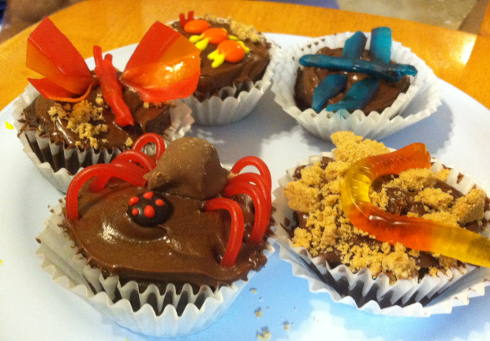
So, originally I was going to make all a mess of cupcakes myself (you can get the details of how to make them here).    But after making these five I realized that this could take all night...and I  suddenly had a brilliant idea!   These cupcakes had been fun to make, even though it was time consuming...and thought how much fun the kids would have DECORATING THEIR OWN CUPCAKES.    So, I brought these for examples, spread out the supplies, then handed the kids a plain cupcake, and plastic knife and a paper plate, and let them decorate their own cupcakes however they wanted.

Did the cupcakes the kids made look anything like the example cakes?   Nope.   Did the kids have a blast making them?   ABSOLUTELY!


And just to have something healthy I also had these caterpillar grapes, 
which a lot of the kids gobbled up!   Originally they were supposed to have 
frosting eyes, but I ran out of time.


We also took off the wrapper on a Sierra Mist and labeled it Bug Juice with a sharpie (like I'd seen on pinterest) .   The kids thought that was HILARIOUS!


Other Fun Buggy Foods

I found these other fun bug themed foods.
We didn't use them for our party, but they sure look fun.

Spiders on a Log (celery snack)


THE PARTY FAVORS


My son's birthday is in April...the perfect time to buy live ladybugs (available at garden centers)....so I thought, why not give away lady bugs in bug jars as a party favor?   They will usually come refrigerated (the cold keeps the docile, and helps them stay alive longer), come with their own bug food.   Be aware that some of them die (and that it's nearly impossible not to get any dead ladybugs into your bug jars), and that they do smell a bit.   Also, if the picture above creeps you out, then I don't suggest this as they look JUST LIKE THAT when you buy ladybugs.   Also, I don't suggest having this as a party favor for indoor parties. 
  1. You can buy bug boxes in bulk online, or make your own with clear cups and press and seal plastic wrap (NOT regular plastic wrap, which comes unstuck too easily).  
  2. I suggest keeping them in the refrigerator until the day before the party so that they both stay alive and stay sluggish (making them easier to redistribute into jars).
  3. Grab a spoon an prepare your jars outside (all lids open), then grab your ladybugs from the fridge, go directly outside, and use a spoon to quickly dish a small amount of them into each of the bug jars.   Then release the rest into your back yard, or put a lid on them, stick them back in the fridge, and take them to the party to release outside there.
  4. Before giving the ladybugs to your party kids, make sure to tell kids to ask their parents if it's ok to take the bugs home (to release in their backyard).  If they want to release the bugs at the party (outside) that's fine too.  
  5. We also printed out a coloring page on the lady bug life cycle we found free on Teachers Pay Teachers.  I can't remember which one, but I like this one with photos (the Ladybugs Grow Up Fast page) and this coloring page here.   The kids were especially facinated to know about the little "alligator" stage of ladybugs, as several had seen those before and not known they were ladybug larve.
Here's a pic of one of the ladybugs that we later released, keeping the aphids off my plants!


Shared on Camera Critters. Quirky Mamma, You're the Star Monday and the Kids Activities Blog

Saturday, August 10, 2019

How to Make Bug Cupcakes


I made the following cupcakes for a bug themed party and it was so fun.   The cupcakes themselves are just regular out of the box cake mix with store bought chocolate frosting, but below you can learn more about how I decorated them.

(DISCLOSURE:   This post contains some Amazon links to some of the more unsual candy used...mostly just cause not everyone would know what it was without seeing a picture even though this is all stuff you can usually find at the supermarket...but I could earn commission from these if you bought something through the link and need to disclose that.). 


THE WORM


To make the dirt I removed the pie crust from a pie tin and broke it up in a plastic baggie, sprinked it on the frosted cupcake, and added a gummie worm.   (You can crumble up graham crackers too...I wanted thicker chunks, and needed the tin for something else anyways, and the pie tins were on sale and actually cheeper than a box of graham crackers, so that's why I went that route.). 


THE BUTTERFLY


I used Fruit by the Foot and Twizzlers Pull and Peel Candy to make the butterfly on this cupcake.   First I cut (with scissors) a roughly 2.5 in segment of fruit by the foot and pinched the middle to make the wings.   I cut two Pull and Peel Strands for antenna and wrapped another length of fruit by the foot around them to make the body, then placed it on top of the wings.   I sort of wish I used a brighter colored icing (like yellow) under the butterfly and dragonfly.   (Note...just learned that Twizzlers has a multicolored version of their Pull and Peel candy, too!   Didn't see that when I was making these!)


THE SPIDER


I used Butterfinger minis (NOT full size) for the abdomen (other candies like Snickers or Milky Way minis could work too...though Butterfinger is particularly rounded).   The legs were made of red vines.   The head is an M&M, and the eyes are made with red writing icing.


THE ANT


The antennas are Twizzlers Pull and Peel Candy (make longer than needed to stick into the cake icing), the body is M&Ms, and the legs are cake icing.   The dirt is crumbled pie crust (see instructions for worm above).


THE DRAGONFLY


The dragonfly is made by first cutting out wings from  Fruit by the Foot, and placing them on the cupcake.  Then I twisted two small segments of Fruit by the Foot to make the antenna, and wrapped more Fruit by the Foot around that to make the body, which was then placed on top of the wings (once again, I think a "flowery" color icing like yellow or pink, or even green for grass, would have looked better under this.)